
Tech
Dyno & Performance
Harley's published horsepower figures were measured at the crankshaft. Magazines measured what reaches the rear wheel, which is always lower. This page keeps the two apart.
Overview
The factory claimed about 65 bhp for the 1983 Shovelhead FXRT and 71.5 to 72 bhp for the Evolution (Cycle World, Aug 1983; Cycle World, Nov 1983; Cycle World, Jan 1987). A stock Evolution on Cycle World's rear-wheel dyno made 51.8 hp at 5000 rpm (Cycle World, May 1994). The gap is normal drivetrain loss plus different test methods, not a sign that the claims were false.
If a spec listing gives an Evo FXR about 64 or 65 hp and 67 lb-ft, it is probably quoting the Shovelhead figures.
Factory claims vs measured
| Engine | Claimed (crank) | Measured (rear wheel) | Source | Confidence |
|---|---|---|---|---|
| 80 ci Shovelhead (1983 FXRT) | 65 bhp at 5400; 67 lb-ft at 3600 | unverified | Cycle World, Aug 1983 | Claimed |
| 1340 Evolution (1984) | 71.5 bhp at 5000; 82.5 lb-ft at 3600 | unverified | Cycle World, Nov 1983 | Claimed |
| 1340 Evolution (1987 FXLR) | 72 bhp at 5200; 82 lb-ft at 3600 | Not measured | Cycle World, Jan 1987 | Claimed |
| 1340 Evolution, stock (1994 Road King) | Not given | 51.8 hp at 5000 rpm; torque peak about 67 lb-ft near 2500 to 2750 rpm (read from the chart) | Cycle World, May 1994 | Measured |
Dyno chart
FXR Archive Phone Dyno app pull · not a drum-dyno sheet
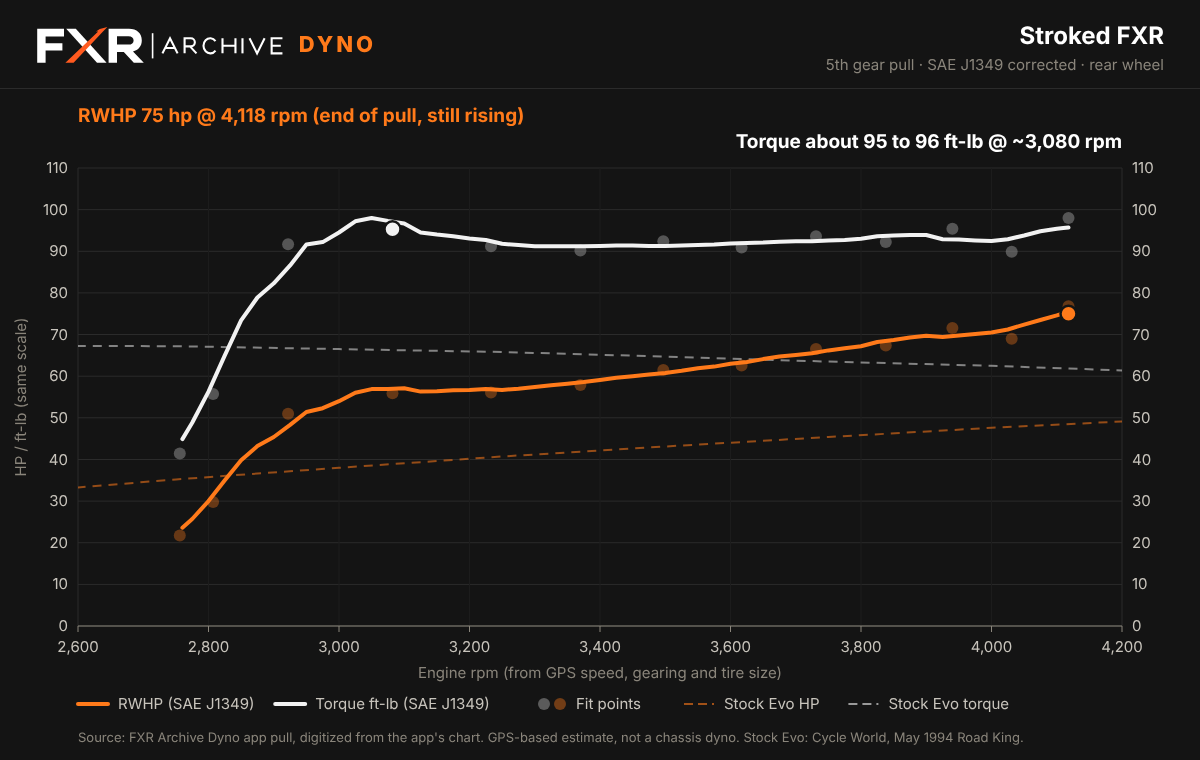
FXR Archive Phone Dyno app pull · not a drum-dyno sheet
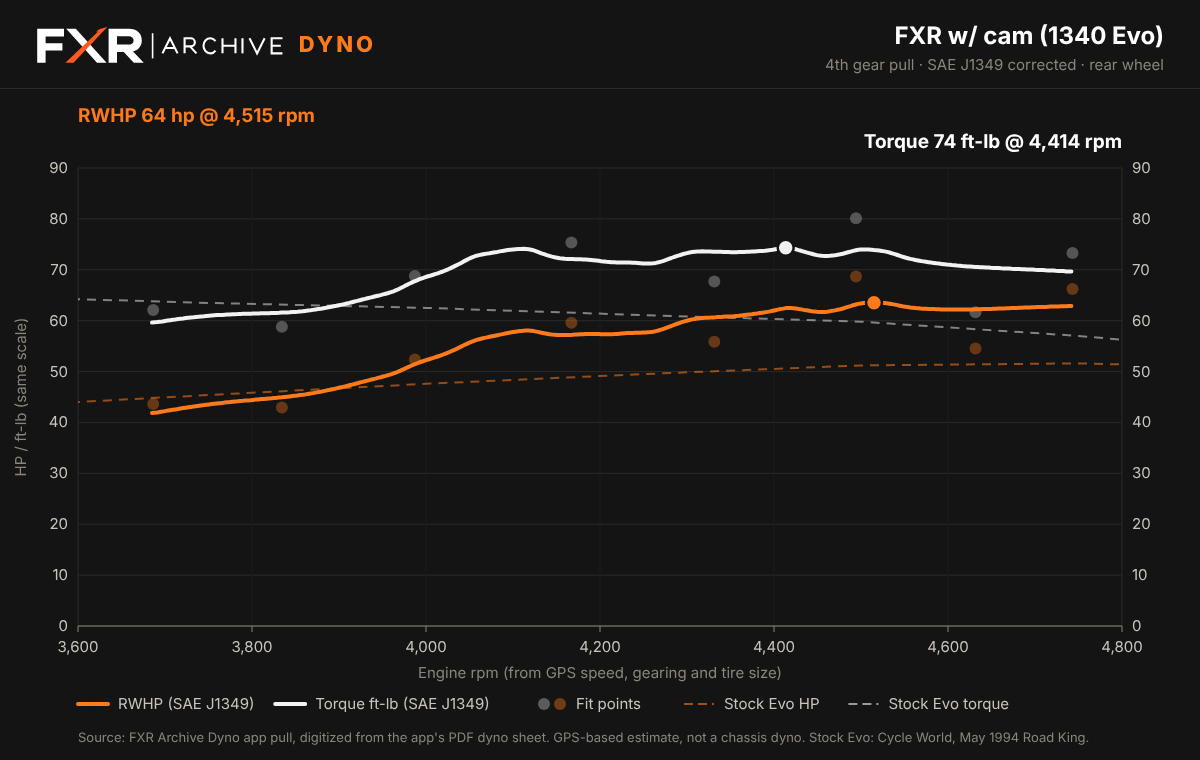
Solid lines: FXR Archive Phone Dyno result (orange horsepower, white torque, one shared scale from 0). Faint dots: the individual points the curve is fitted through, one per pair of GPS readings. Dashed: stock Evo reference. No error bars. These are single pulls, so expect about 5 to 15% difference from a drum dyno.
How these pulls were made: FXR Archive Phone Dyno (Beta).
Road tests & performance
Every period test we have found, with weights, prices and braking, model by model: Period Road Tests →
| Test | Result | Source |
|---|---|---|
| 0 to 60 mph | 6.9 s (1982 FXRS) | Cycle World, Dec 1981 |
| Quarter mile | 14.26 s at 91.46 mph (1982 FXRS); 14.44 s at 89.02 mph (1983 FXRT); 13.95 s at 91.72 mph (1987 FXLR); 13.17 s at 100.11 mph (1990 FXRS-SP) | Cycle World, Dec 1981; Cycle World, Aug 1983; Cycle World, Jan 1987; Cycle World, Jul 1990 |
| Top speed | 99 mph in a half mile (1982 FXRS); 101 mph (1983 FXRT); 107 mph (1987 FXLR); 114 mph (1990 FXRS-SP) | Cycle World, Dec 1981; Cycle World, Aug 1983; Cycle World, Jan 1987; Cycle World, Jul 1990 |
| Fuel economy | 50 mpg (1982 FXRS); 47 mpg (1983 FXRT); 45 mpg (1987 FXLR); 41 mpg (1990 FXRS-SP) | Cycle World, Dec 1981; Cycle World, Aug 1983; Cycle World, Jan 1987; Cycle World, Jul 1990 |
| Braking, 60 to 0 mph | 123 ft (1982 FXRS); 150 ft (1983 FXRT); 125 ft (1987 FXLR) | Cycle World, Dec 1981; Cycle World, Aug 1983; Cycle World, Jan 1987 |
Methodology
How the FXR Archive Dyno app measures power
The app reads GPS speed about once a second. Each pair of back-to-back readings becomes one data point: the change in speed divided by the time between them gives acceleration, at the average of the two speeds. The force at the rear tire is total weight (bike, rider, cargo) times that acceleration, plus air drag from the bike preset's drag area, plus the front tire's rolling drag, which rises with speed. Force times speed gives rear-wheel horsepower. Engine rpm comes from road speed, tire size and the gear you pick, and torque is horsepower × 5,252 ÷ rpm. Results are corrected to SAE J1349 using weather looked up automatically.
Tap Record pull and roll on. The pull arms once acceleration stays up for two readings, then auto-ends on roll-off: about 2 seconds of low acceleration while speed stops rising and the bike clearly slows. A quick gear change doesn't end it. Automatic trim then keeps only the rising part, from where acceleration climbs above 60% of the pull's peak to the first sustained drop below 30%, so cruising and coasting can't bend the curve.
Only the front tire's rolling drag is counted because a drum dyno such as a Dynojet never sees the rear tire's loss and the front wheel doesn't turn. So the numbers read like a drum-dyno sheet.
Stacking lines up several pulls of the same bike and gear by rpm, pools their points and drops ones that disagree. Pulls run both ways on the same road cancel most wind and grade.
Limits: each pull assumes a level road and still air, and drag and tire values are estimates. Expect about 5 to 15% agreement with a drum dyno. One reading a second can't catch quick changes, and the curve is smoothed over roughly ±200 rpm.
Sources
- Cycle World, "Harley-Davidson FXRS" road test, December 1981. Link
- Cycle World, "Harley-Davidson FXRT" road test, August 1983. Link
- Cycle World, "Harley-Davidson FLHTC" road test (first Evolution engine claims), November 1983. Link
- Cycle World, "Harley-Davidson Low Rider Custom FXLR" road test, January 1987. Link
- Cycle World, "Harley-Davidson FXRS-SP" road test, July 1990. Link
- Cycle World, "Harley-Davidson Road King" road test (stock Evolution rear-wheel dyno run), May 1994. Link
- SAE International, J1349 Engine Power Test Code, Spark Ignition and Compression Ignition, Net Power Rating. Link
About the unverified flag: it marks a detail we have not yet been able to confirm in a published source, such as a factory document, owner's or service manual, or period magazine test. Where a table cell shows only the flag, we have not found a reliable figure. We keep these details visible so they can be checked. If you have a source, please tell us.
Full bibliography and image credits: Sources & Credits. Magazine pages are linked, never copied or hosted here. Spot an error? Tell us.