
Tech | FXRS family
FXRS, FXRS-CONV, FXRS-SP... are you confused?
Three model codes, one frame, and a lot of used-bike ads that mix them up. Here is how they split and how to tell which one is sitting in front of you.
Short answer
All three are the same rubber-mount FXR chassis, and from 1984 on they share the 1340 Evo. The FXRS is the base Low Glide, later the Low Rider. The FXRS-SP is that bike with longer suspension and a second front disc. The FXRS-CONV is the SP with a taller bar, a windshield that comes off with an Allen key and soft bags that come off with no tools (Cycle World, 1987; Cycle World, 1989). Get the suspension right and you have most of the story.
How the family grew
- 1982: the FXRS Super Glide II launches beside the FXR with the Shovelhead. Cast wheels, two-tone paint (Rider; Hot Bike).
- 1984: Evo engine, new name, Low Glide. Harley lowered the suspension and fitted a single front disc. The magazines panned it, because the lost ground clearance hurt handling and braking (Rider).
- 1985: belt final drive. Harley answers the complaints with the FXRS-SP “Optional Performance/Suspension Package”: the FXRT's taller suspension and dual discs, without the fairing and bags (Rider).
- 1986: the Low Glide becomes the Low Rider and keeps the SP option (Rider).
- 1987: the FXRS-SP Sport Edition Low Rider becomes its own model (Rider). Harley's 1987 owner's manual already gives the FXRS Sport Edition its own spec column (1987 owner's manual). Hot Bike says 1988, so you will see both years quoted.
- 1989: the Convertible arrives, about 300 built that first year (Rider). Cycle World says Harley built it by taking an FXRS Sport Edition and adding the bar, shield and bags (Cycle World, 1989).
- 1993: the FXRS Low Rider is dropped and the Dyna FXDL takes the name (Rider; Wikipedia). Wikipedia says the SP and the Convertible were still sold that year.
Side by side
Factory numbers from Harley's 1990 owner's manual, which lists all three in one table. Same frame. The difference is legs.
| FXRS | FXRS-SP | FXRS-CONV | |
|---|---|---|---|
| Wheelbase | 63.13 in | 64.70 in | 64.70 in |
| Saddle height | 26.50 in | 27.50 in | 27.50 in |
| Road clearance | 5.25 in | 6.00 in | 6.00 in |
| Overall height | 48.00 in | 50.00 in | 59.50 in (with shield) |
| Dry weight | 575 lb | 585 lb | 615 lb |
| Suspension travel | Base | About 2 in more, front and rear | Same as SP |
| Front brake | Single disc | Twin discs | Twin discs (SP running gear) |
| Handlebar | Low Rider bar | Low, flat bar | Higher bar |
| VIN model code (5th and 6th) | EB | EG | EM |
| Total built | 30,419 | 5,647 (1987 to 1993) | 7,517 |
Sources: dimensions and weight, 1990 owner's manual; travel and brakes, Cycle World, 1990; bars, Cycle World, 1987 and Cycle World, 1989; VIN codes, Rider. Rider lists the Convertible code as “FXR-C”. Totals are derived from The Bazar Book of FXRs by Nick Hinzo. The FXRS total covers the whole run and includes the 1985 and 1986 SP option bikes.
Read that last row twice. Harley built more Convertibles than standalone SPs. If you want the rare one, it is the SP.
Telling them apart in a parking lot
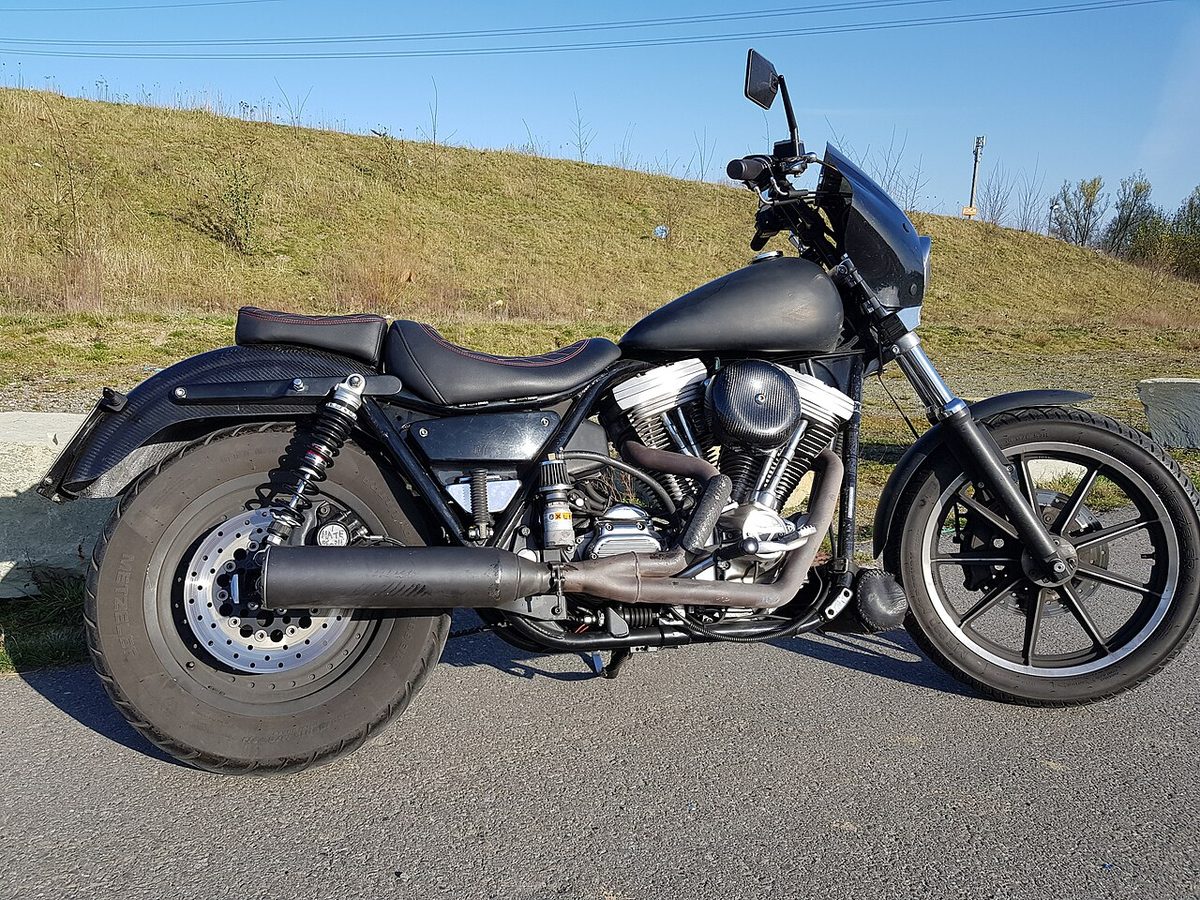

- Count the front discs. One disc on an Evo FXRS is stock. Two discs points to an SP or a Convertible (Cycle World, 1990). A second caliper bolts on, so this is a clue, not proof.
- Look at the stance. The SP and Convertible sit an inch taller at the saddle, ride 3/4 in higher off the ground and stretch about 1.5 in more wheelbase (1990 manual). Longer shocks are the easy tell from the side.
- Check the bar. The SP got a low, flat bar (Cycle World, 1987). The Convertible got a higher one (Cycle World, 1989).
- Convertible hardware. The shield comes off with a two-turn twist on four Allen bolts. Each bag hangs on three big knobs, no tools (Cycle World, 1989). Cycle World said they leave no ugly brackets behind, so a stripped Convertible looks a lot like an SP.
- Read the VIN. Positions 5 and 6: EB is an FXRS, EG an FXRS-SP, EM a Convertible (Rider). That is the only tell nobody can bolt on. Run it through our VIN decoder. The 1985 and 1986 SP option bikes were FXRS models with a package, so expect an FXRS code on those unverified.
What it means if you are buying
Parts move between these bikes. Dual discs and longer shocks bolt on. Plenty of FXRS Low Riders have been upgraded and plenty of SPs have been lowered. Pay for the VIN and the paperwork, not the ad title.
The SP is the rider's pick. Cycle World called the 1987 Low Rider Sport “the most well-rounded Harley-Davidson ever” (Cycle World, 1987). The 1990 test said the extra travel and twin discs turn the “relatively uninspiring single-front-disc FXRS” into “a different machine altogether” and ran the quarter in 13.17 seconds at 100.11 mph (Cycle World, 1990). The cost is a taller seat. If 27.5 in is a stretch for you, the FXRS fits better.
Pegs and kickstand. Both SP tests griped about the pegs: the left one fights the clutch cover in 1987, the right one sits close to the exhaust and air cleaner in 1990. Ride it hard and the kickstand still scrapes, even with the preload cranked up (Cycle World, 1987; Cycle World, 1990).
Convertible checks. Make sure the shield, its mounts and both bags come with it. Without them it is an SP with a VIN that says otherwise, and you should price it that way. The bags are small and won't hold a full-face helmet. The shield is tall for short riders and only adjusts a little. The air fork is plumbed through the handlebar with the Schrader valve in the end of the left grip, and Cycle World's test bike dribbled fork oil out of the bar. Look for that (Cycle World, 1989).
Our take. Same frame, same motor, same parts counter. Buy the one that fits your inseam and your riding, then let the VIN settle the argument at bike night.
FXR Archive | Articles | October 2026