
Models
FXRS-SP Low Rider Sport
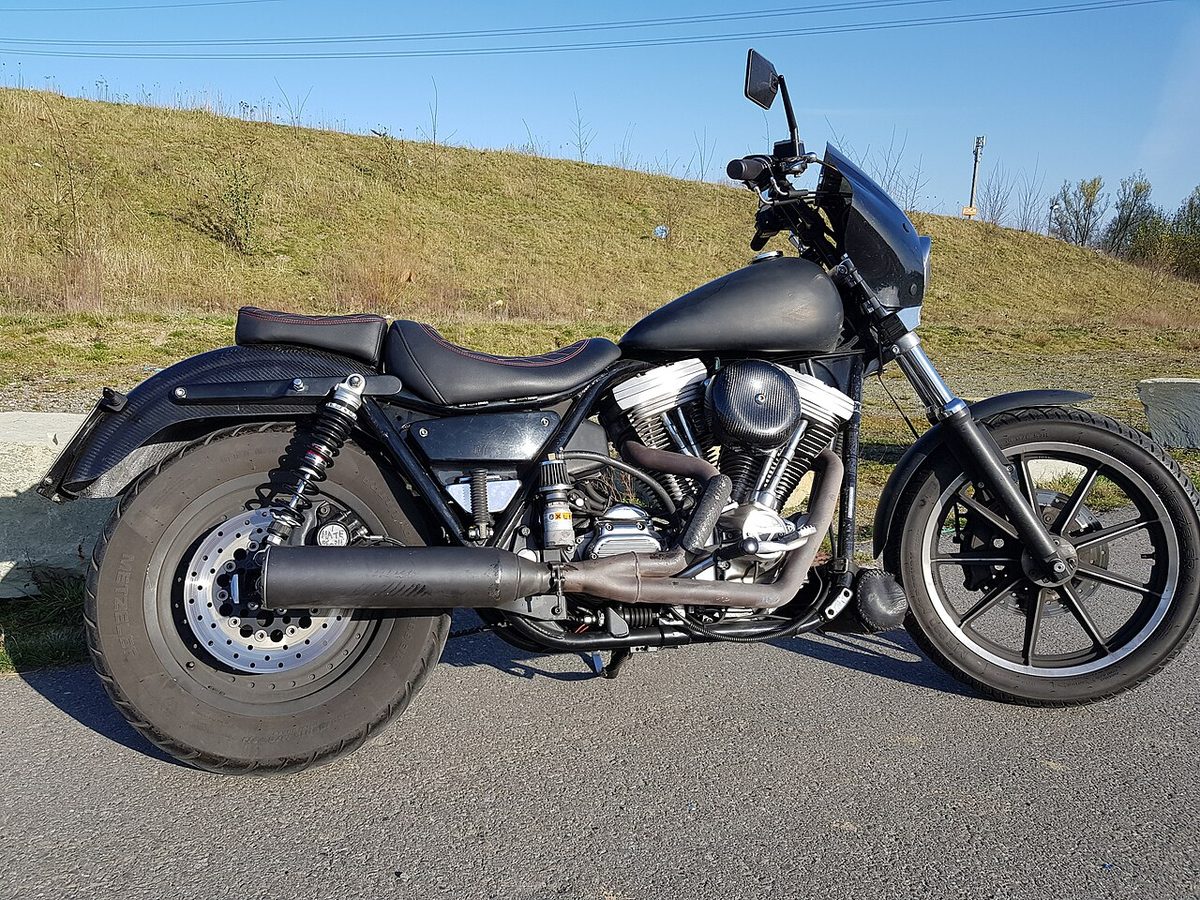
The FXRS with the FXRT's taller suspension and twin front discs, but no fairing. Many riders see it as the best handling FXR.
Overview
Rider says the lowered Low Glide drew poor reviews, so for 1985 Harley offered an FXRS-SP "Optional Performance/Suspension Package" with the FXRT's taller suspension and dual discs (Rider, Sep 2017). The SP option carried on for the 1986 Low Rider (Rider, Sep 2017).
When it became a separate model is unclear: Rider says 1987 and Hot Bike lists 1988 (Rider, Sep 2017; Hot Bike, "Separating the Men From the Boys"). Moto Gallery gives 1986 to 1993 (Moto Gallery FXR overview). Harley's 1987 owner's manual already gives the FXRS Sport Edition its own column in the spec tables (Harley-Davidson 1987 Owner's Manual). Wikipedia says the Low Rider Sport was discontinued in 1994 (Wikipedia, "Harley-Davidson Super Glide").
Cycle World's July 1990 test found about 2 inches more suspension travel than the FXRS and twin front discs, and ran a 13.17 second quarter mile at just over 100 mph (Cycle World, Jul 1990).
Years made
1985 option; separate model 1987 or 1988 to 1993 or 1994.
| Model year | Units built | Notes | Confidence | Source |
|---|---|---|---|---|
| 1985 to 1986 | Option package | On FXRS | Reported | Rider, Sep 2017 |
| 1987 or 1988 onward | unverified | Separate model Conflict | Needs source | Rider, Sep 2017; Hot Bike, "Separating the Men From the Boys" |
Identifying features
- Longer-travel suspension than the FXRS (Rider, Sep 2017; Cycle World, Jul 1990)
- Twin front discs (Cycle World, Jul 1990)
- VIN model code EG (Rider, Sep 2017)
Specs
Period road tests: 3 magazine tests with measured figures. See the Period Road Tests →
1990 FXRS-SP as tested by Cycle World, July 1990, plus chassis figures (marked 1987) from Cycle World's June 1987 test of the FXRS Low Rider Sport, which printed only a short spec box. Harley's factory figures are in the second table. They confirm the 27.5 in seat height, but list 585 lb dry where Cycle World printed 570 lb Conflict.
| Item | Value | Source |
|---|---|---|
| Engine | 1340cc Evolution | Cycle World, Jul 1990 |
| Suspension | About 2 in more travel than the FXRS Low Rider, front and rear | Cycle World, Jul 1990 |
| Front brakes | Twin discs (the FXRS had one) | Cycle World, Jul 1990 |
| Weight | 571 lb with tank empty | Cycle World, Jul 1990 |
| Fuel capacity | 4.1 gal | Cycle World, Jul 1990 |
| Tested performance | Quarter mile 13.17 s at 100.11 mph; top speed 114 mph; 41 mpg | Cycle World, Jul 1990 |
| Period list price | $9,775 | Cycle World, Jul 1990 |
| Wheelbase (1987) | 64.7 in | Cycle World, Jun 1987 |
| Rake / trail (1987) | 31° / 4.8 in | Cycle World, Jun 1987 |
| Seat height (1987) | 27.5 in (Harley's 1987 manual also lists 27.50 in) | Cycle World, Jun 1987; Harley-Davidson 1987 Owner's Manual |
| Claimed output (1987) | 72 bhp at 5200 rpm; 83 lb-ft at 3600 rpm | Cycle World, Jun 1987 |
| Dry weight (1987) | 570 lb | Cycle World, Jun 1987 |
| Period list price (1987) | $8,649 | Cycle World, Jun 1987 |
1987 FXRS Sport Edition and 1990 FXRS-SP, factory figures from Harley's owner's manuals
Known issues
Common problems across the FXR family, by model year: Known Issues →
Rubber mounts and stabilizer links
The whole design depends on three elastomer mounts and two adjustable stabilizer links (Rider, Sep 2017). Buyer's guides suggest checking them on any used FXR (Moto Gallery FXR overview). Typical wear symptoms and replacement intervals unverified.
1992 to 1994: caged cam bearing
Rider notes that 1992 Evos switched to a caged needle bearing for the camshaft and calls a full-complement bearing a required swap when changing cams (Rider, Sep 2017).
Photos
No FXRS-SP / Sport photos here yet. We only publish photos that are free to use or that owners send us with permission. Have one?
Related models
FXRS
The dressier twin of the first FXR. It later became the Low Glide, then the Low Rider, and was the most common FXR of the early years.

FXRT
The faired sport tourer of the family, with a frame-mounted fairing and hard bags that started life on Harley's cancelled Nova project.
FXLR
The custom-styled FXR, with a skinny 21 inch front wheel, solid rear wheel and blacked-out engine.
Sources
- Kip Woodring, "Motorhead Memo: The Gentleman's Express", Rider Magazine, September 20, 2017 (year-by-year FXR history and VIN model codes). Link
- Hot Bike, "Separating the Men From the Boys: The History of the FXR" (photos from the Harley-Davidson Archives; interviews Bob LeRoy). Link
- Cycle World, "Harley-Davidson FXRS-SP" road test, July 1990. Link
- Cycle World, "Harley-Davidson FXRS Low Rider Sport", June 1987 (part of a cruiser comparison; short spec box). Link
- Harley-Davidson Motor Co., 1987 All Models Owner's Manual (FXRT specifications page 12, FXR, FXRS, FXRS Sport Edition and FXLR specifications page 34, tire pressures pages 14 and 36). Scanned copy hosted by Ratbike Service. Link
- Harley-Davidson Motor Co., 1990 All Models Owner's Manual (FXRT specifications page 18, FXR, FXRS, FXRS-SP, FXRS-CON and FXLR specifications pages 50 to 51, tire pressures page 52). Scanned copy hosted by Ratbike Service. Link
- Wikipedia, "Harley-Davidson Super Glide" (FXR section), and the sources it cites, including Andy Hornsby, "A Potted History of Harley-Davidson", American-V. Link
- Moto Gallery, "1982-2000 Harley-Davidson FXR" resource guide (secondary buyer's guide). Link
About the unverified flag: it marks a detail we have not yet been able to confirm in a published source, such as a factory document, owner's or service manual, or period magazine test. Where a table cell shows only the flag, we have not found a reliable figure. We keep these details visible so they can be checked. If you have a source, please tell us.
Full bibliography and image credits: Sources & Credits. Magazine pages are linked, never copied or hosted here. Spot an error? Tell us.