
History
Timeline 1982 to 1994
Year by year through the FXR's life, from the Super Glide II to the last CVO FXR4.
Jump to year
Year by year
- Before
1971: The original FX Super Glide mixes Big Twin and Sportster parts. It is the ancestor of the FXR (Hot Bike, "The Saga of the FXR"; Wikipedia, "Harley-Davidson Super Glide").
1980: The FLT Tour Glide arrives with a rubber-mounted engine and five-speed gearbox, the drivetrain the FXR would borrow (Hot Bike, "Separating the Men From the Boys").
1981: A management group buys Harley-Davidson back from AMF. The FXR goes on sale that summer as a 1982 model (Hot Bike, "Separating the Men From the Boys"; Rider, Sep 2017).
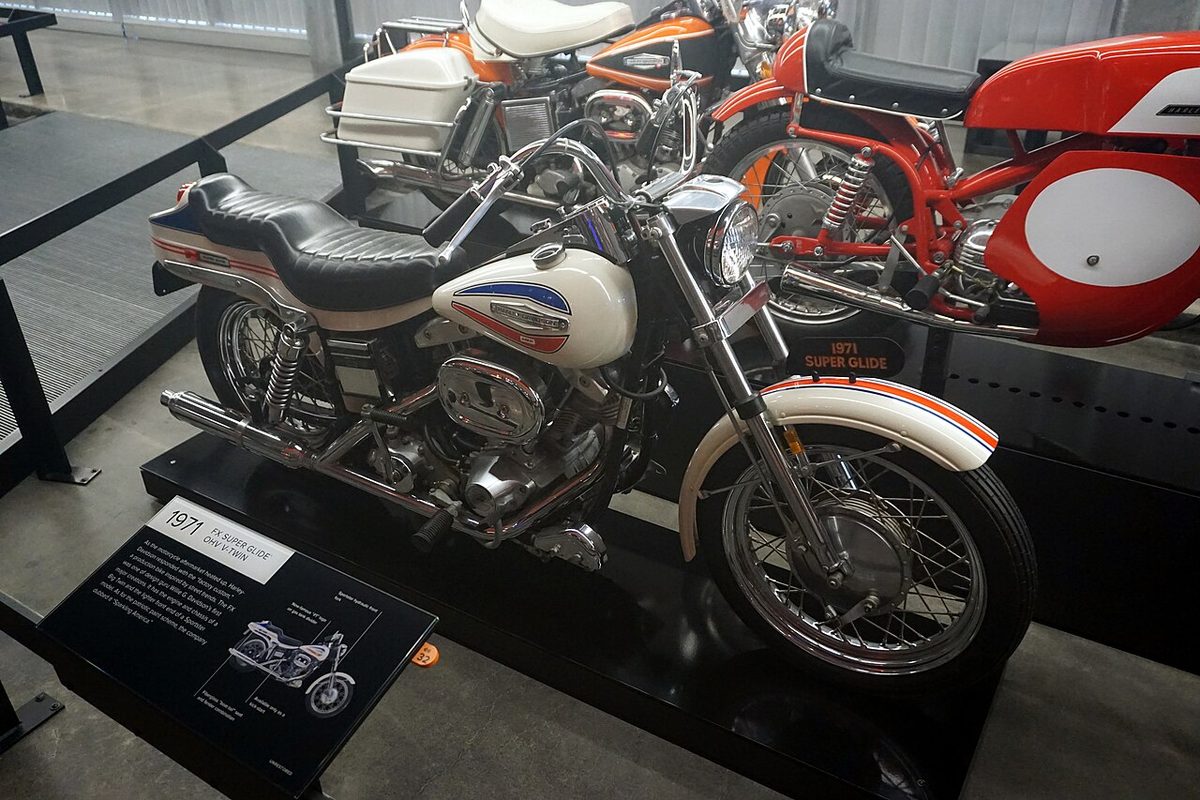
The 1971 FX Super Glide, the original Super Glide the FXR family later replaced. Photo: Michael Barera, Wikimedia Commons, CC BY-SA 4.0 (resized). - 1982
The FXR Super Glide II (laced wheels, single-color paint) and the FXRS (cast wheels, two-tone paint, more chrome) launch with the 80 ci Shovelhead, five-speed gearbox, chain final drive and triple disc brakes (Hot Bike, "Separating the Men From the Boys"; Cycle World, Dec 1981).
Launch ads promise the bike will "separate the men from the boys" (Hot Bike, "Separating the Men From the Boys").
Hot Bike says FXRs were Harley's top-selling Big Twins that year (Hot Bike, "The Saga of the FXR"). Reported production: FXR 3,065, FXRS 3,190 (shovelhead.us, 1982).
- 1983
The FXRT Sport Glide joins the line with a frame-mounted fairing and hard bags first designed for Harley's cancelled Nova V-four project (Hot Bike, "Separating the Men From the Boys"). It has air suspension with anti-dive and an enclosed chain (Cycle World, Aug 1983).
The FXR and FXRS carry on largely unchanged (Cycle World, Dec 1982). This is the FXRT's only Shovelhead year (shovelhead.us, 1983).
- 1984
The Evolution engine replaces the Shovelhead (Hot Bike, "Separating the Men From the Boys"; Cycle World, Sep 1984). A few very early 1984 bikes may still have Shovelheads (shovelhead.us, 1984).
The FXRS becomes the Low Glide, with lower suspension and a single front disc. The base FXR is dropped for the year (Rider, Sep 2017; shovelhead.us, 1984).
New: the FXRP police model and the limited FXRDG Disc Glide, which Cycle World named its Best Cruiser (Rider, Sep 2017; Cycle World, Oct 1984).
A wet diaphragm clutch replaces the dry clutch during the model year (Rider, Sep 2017; Cycle World, Sep 1984).
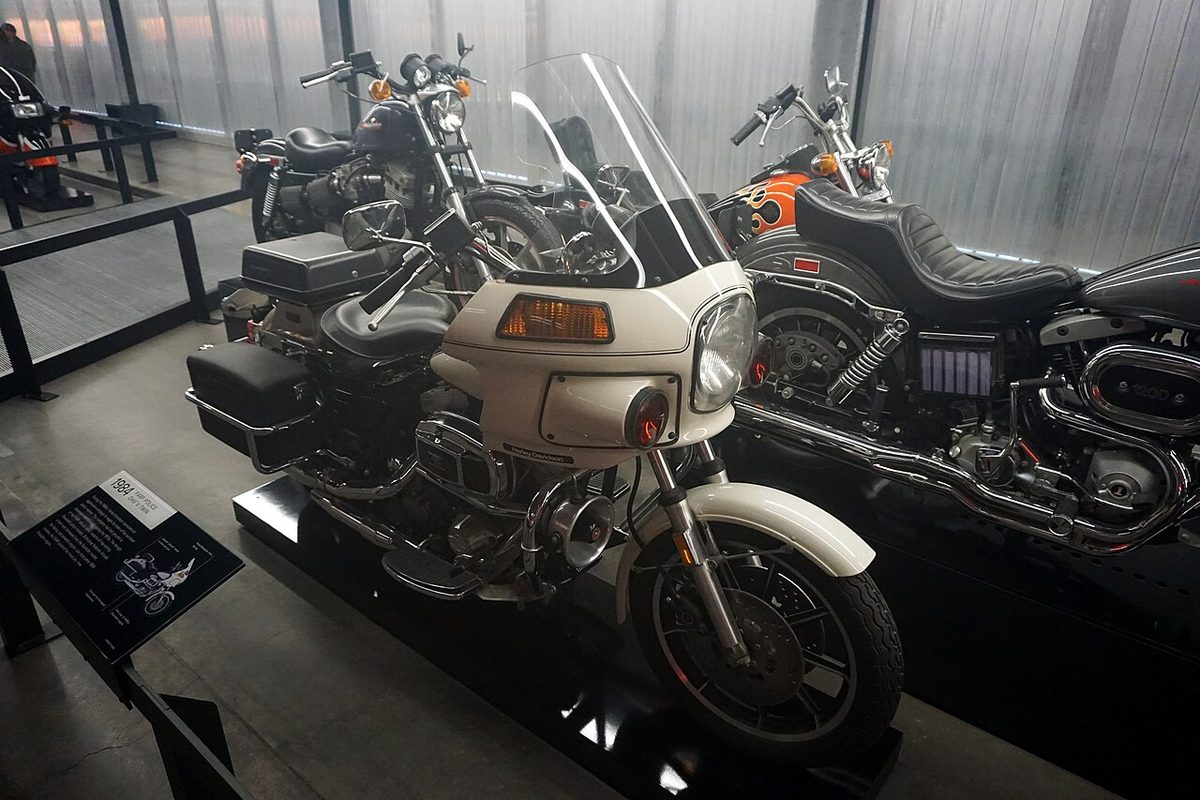
1984 FXRP police model at the Harley-Davidson Museum. Photo: Michael Barera, Wikimedia Commons, CC BY-SA 4.0 (resized). - 1985
Belt final drive arrives (Hot Bike, "Separating the Men From the Boys"; Rider, Sep 2017). Early 1985 bikes can have leftover parts such as a dry clutch or even chain drive (Hot Bike, "The Saga of the FXR").
New: the limited FXRC Low Glide Custom, and an FXRS-SP performance and suspension package (Rider, Sep 2017).
- 1986
FXR models replace the old FX line. The base FXR returns as the Super Glide, and the FXRS becomes the Low Rider (Hot Bike, "Separating the Men From the Boys"; Wikipedia, "Harley-Davidson Super Glide"; Rider, Sep 2017).
New: the FXRD, a touring version of the FXRT with a trunk (Hot Bike, "Separating the Men From the Boys"; Rider, Sep 2017).
- 1987
New: the FXLR Low Rider Custom, with a 21 inch laced front wheel and a solid rear wheel (Hot Bike, "Separating the Men From the Boys"; Cycle World, Jan 1987).
Rider says the FXRS-SP became a separate model this year; Hot Bike lists it under 1988 (Rider, Sep 2017; Hot Bike, "Separating the Men From the Boys").
- 1988
Harley's 85th anniversary. Rider reports 850 numbered anniversary FXRS models in black and gold, 39mm forks across the line, and buckhorn bars on the base FXR (Rider, Sep 2017; Hot Bike, "Separating the Men From the Boys").
- 1989
A 40mm Keihin CV carburetor arrives (Rider, Sep 2017).
Rider dates the FXRS Convertible, with a quick-detach windshield and soft bags, to 1989 with about 300 built that year. Hot Bike says 1990 (Rider, Sep 2017; Hot Bike, "Separating the Men From the Boys").
- 1990
Clutch changes, including a revised diaphragm clutch (Rider, Sep 2017). Cycle World tests the FXRS-SP and records a 13.17 second quarter mile (Cycle World, Jul 1990).
- 1991
The Dyna chassis debuts on the limited FXDB Sturgis. From now until 1994, FXRs and Dynas are built side by side (Hot Bike, "The Saga of the FXR"; Wikipedia, "Harley-Davidson Super Glide").
- 1992
Rider notes a switch to a caged needle cam bearing and recommends swapping it for a full-complement bearing (Rider, Sep 2017). See Known issues on the model pages.
Guides differ on whether the FXRT and FXRS Low Rider ended after 1992 or 1993 (Rider, Sep 2017; Moto Gallery FXR overview).
- 1993
The FXRT and the FXRS Low Rider are dropped, and the Dyna FXDL takes the Low Rider slot. The FXR, FXLR, FXRS-SP and Convertible carry on (Rider, Sep 2017; Wikipedia, "Harley-Davidson Super Glide").
- 1994
The last model year of regular FXR production (Hot Bike, "The Saga of the FXR"). For 1995, Dyna models replace the remaining FXRs (Wikipedia, "Harley-Davidson Super Glide"; Hot Bike, "The Saga of the FXR").
- After
1999: Harley's new custom program builds the FXR2 and FXR3 in York, Pennsylvania, 900 of each (Cycle World, May 1999; Hot Bike, "The Saga of the FXR").
2000: The FXR4 closes the story. Hot Bike says 1,000 were built; Rider says the run was set for 970 (Hot Bike, "The Saga of the FXR"; Rider, Sep 2017). It was the last Evolution Big Twin (Rider, Sep 2017).
.jpg)
.jpg)
About dates
Harley model years start in the summer or fall before the calendar year, so a "1982" FXR was on sale in 1981. Where sources disagree on a year, both are shown. Production figures for 1982 to 1984 come from an enthusiast site and are labelled Reported; we have not found published figures for 1985 onward unverified.
Sources
- Hot Bike, "Separating the Men From the Boys: The History of the FXR" (photos from the Harley-Davidson Archives; interviews Bob LeRoy). Link
- Hot Bike, "The Saga of the FXR" (includes an interview with Erik Buell). Link
- Kip Woodring, "Motorhead Memo: The Gentleman's Express", Rider Magazine, September 20, 2017 (year-by-year FXR history and VIN model codes). Link
- Cycle World, "Harley-Davidson FXRS" road test, December 1981. Link
- Cycle World, "Harley-Davidson for 1983", December 1982. Link
- Cycle World, "Harley-Davidson FXRT" road test, August 1983. Link
- Cycle World, "Long-Term Test: Harley-Davidson FXRS", September 1984. Link
- Cycle World, "Ninth Annual Ten Best Motorcycles of the Year", October 1984. Link
- Cycle World, "Harley-Davidson Low Rider Custom FXLR" road test, January 1987. Link
- Cycle World, "Harley-Davidson FXRS-SP" road test, July 1990. Link
- Matthew Miles, "Return of the FXR", Cycle World, May 1999. Link
- Wikipedia, "Harley-Davidson Super Glide" (FXR section), and the sources it cites, including Andy Hornsby, "A Potted History of Harley-Davidson", American-V. Link
- Moto Gallery, "1982-2000 Harley-Davidson FXR" resource guide (secondary buyer's guide). Link
- shovelhead.us, "1982 Harley-Davidson" model year history page (enthusiast site; production figures). Link
- shovelhead.us, "1983 Harley-Davidson" model year history page (enthusiast site; production figures). Link
- shovelhead.us, "1984 Harley-Davidson" model year history page (enthusiast site; production figures). Link
About the unverified flag: it marks a detail we have not yet been able to confirm in a published source, such as a factory document, owner's or service manual, or period magazine test. Where a table cell shows only the flag, we have not found a reliable figure. We keep these details visible so they can be checked. If you have a source, please tell us.
Full bibliography and image credits: Sources & Credits. Magazine pages are linked, never copied or hosted here. Spot an error? Tell us.