
History
Where the FXR came from, why riders loved it, and why Harley replaced it.
Overview
The FXR went on sale in the summer of 1981 as a 1982 model, only months after Harley-Davidson's management bought the company back from AMF (Hot Bike, "Separating the Men From the Boys"; Rider, Sep 2017). Harley needed to show it could build a modern rider's bike, and the FXR was that statement (Hot Bike, "The Saga of the FXR").
The idea was simple. Take the 80 cubic inch Shovelhead engine and five-speed gearbox from the 1980 FLT Tour Glide, Harley's first modern rubber-mounted bike, and build a lighter, sportier FX-style bike around them (Hot Bike, "Separating the Men From the Boys"). The Tour Glide frame turned out to be a poor fit, so the team designed a new one (Hot Bike, "The Saga of the FXR"). Wikipedia, citing Andy Hornsby's history, describes it as essentially an FLT chassis with bigger tubes and a more conventional steering head (Wikipedia, "Harley-Davidson Super Glide").
Getting it right took time. Erik Buell, who joined the project to fix its handling, told Hot Bike the early prototypes "wobbled almost continuously" on the test track, and that Harley delayed the launch so the team could fix it (Hot Bike, "The Saga of the FXR"). The result was, in Hot Bike's words, the stiffest frame Harley ever produced. Harley's chief engineer told Cycle World it was five times stiffer than the FX frame (Cycle World, Dec 1981).
The family grew fast: the faired FXRT in 1983, the Evolution engine in 1984, belt final drive in 1985, and by 1986 FXR models had replaced the old FX line and taken over the Super Glide and Low Rider names (Hot Bike, "Separating the Men From the Boys"; Wikipedia, "Harley-Davidson Super Glide").
The FXR was expensive to build. Its frame used welded stamped-steel parts assembled by hand, before robotic welding (Hot Bike, "The Saga of the FXR"). The Dyna, launched with the 1991 FXDB Sturgis, was designed to be easier to build and was Harley's first bike designed fully in CAD (Hot Bike, "The Saga of the FXR"). FXRs and Dynas were built side by side until 1994, the FXR's last regular model year (Hot Bike, "The Saga of the FXR").
The story did not quite end there. In 1999 Harley's new custom program built the FXR2 and FXR3, and in 2000 the FXR4, the last FXRs and the last Evolution Big Twins (Cycle World, May 1999; Rider, Sep 2017). See CVO 1999 to 2000.
.jpg)
At a glance
Model years
1982 to 1994, plus CVO models in 1999 and 2000 (Hot Bike, "The Saga of the FXR"; Cycle World, May 1999).
Engines
80 ci Shovelhead in 1982 and 1983, then the 1340cc Evolution from 1984 (Hot Bike, "Separating the Men From the Boys"; Rider, Sep 2017).
The big idea
A rubber-mounted engine on three elastomer mounts plus stabilizer links, in a stiff welded frame (Rider, Sep 2017).
Total built
No official lifetime total has been published. unverified
What does FXR stand for?
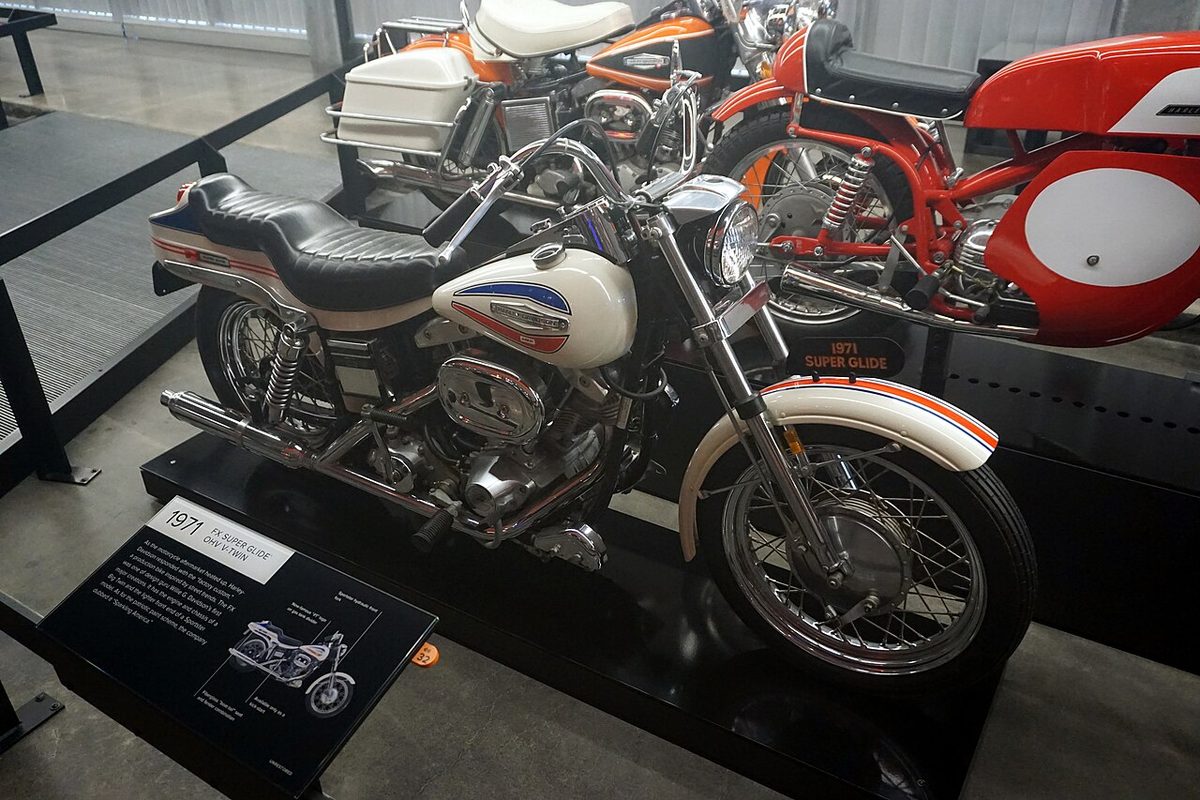
Hot Bike breaks the name down as F for Big Twin, X for the Sportster-style front end, and R for the rubber engine mounts (Hot Bike, "The Saga of the FXR"). The original 1971 FX used Big Twin and Sportster parts, and Wikipedia notes that "FX" has also been explained as "Factory Experimental", citing Willie G. Davidson's company history (Wikipedia, "Harley-Davidson Super Glide"). The first bikes were sold as the Super Glide II (Hot Bike, "The Saga of the FXR").
In this section
Sources
- Hot Bike, "Separating the Men From the Boys: The History of the FXR" (photos from the Harley-Davidson Archives; interviews Bob LeRoy). Link
- Hot Bike, "The Saga of the FXR" (includes an interview with Erik Buell). Link
- Kip Woodring, "Motorhead Memo: The Gentleman's Express", Rider Magazine, September 20, 2017 (year-by-year FXR history and VIN model codes). Link
- Cycle World, "Harley-Davidson FXRS" road test, December 1981. Link
- Wikipedia, "Harley-Davidson Super Glide" (FXR section), and the sources it cites, including Andy Hornsby, "A Potted History of Harley-Davidson", American-V. Link
- Matthew Miles, "Return of the FXR", Cycle World, May 1999. Link
About the unverified flag: it marks a detail we have not yet been able to confirm in a published source, such as a factory document, owner's or service manual, or period magazine test. Where a table cell shows only the flag, we have not found a reliable figure. We keep these details visible so they can be checked. If you have a source, please tell us.
Full bibliography and image credits: Sources & Credits. Magazine pages are linked, never copied or hosted here. Spot an error? Tell us.